

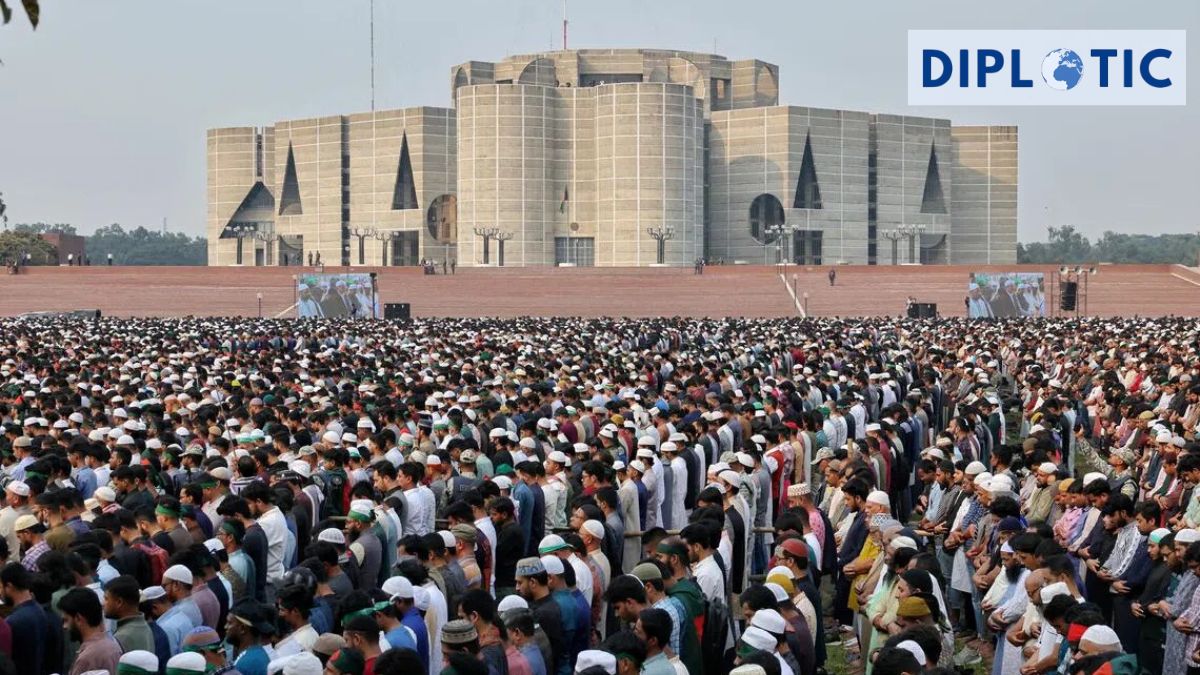
Bangladesh observes state mourning as thousands gather in Dhaka for the funeral of slain uprising activist Sharif Osman Hadi. Heavy police deployment underscores the political gravity of the moment and the nation’s ongoing struggle for justice and democratic reform.
Bangladesh entered a solemn chapter of national reflection as the government declared state mourning and organized a high-profile funeral for slain uprising activist Sharif Osman Hadi, whose death has sent shockwaves through the country’s political and social landscape. The funeral, held at Bangladesh’s parliament house in Dhaka, drew thousands of mourners, civil society figures, and political leaders, highlighting Hadi’s symbolic role in the recent wave of popular unrest.
Under tight security, police filled the streets surrounding the parliament complex, signaling the authorities’ concern over both public safety and the broader implications of the activist’s killing. The event was not only a farewell to a prominent figure but also a moment of collective grief for a nation grappling with deep political tensions and demands for reform.
Heavy Police Presence Reflects Political Sensitivity
The extensive deployment of law enforcement across central Dhaka was one of the most striking aspects of the funeral. Armored vehicles, barricades, and uniformed officers lined major roads leading to the parliament house, ensuring that the ceremony proceeded without disruption.
Officials described the security measures as precautionary, citing the emotionally charged atmosphere and the large turnout expected. Analysts, however, note that the heavy police presence also reflects the high political sensitivity surrounding Sharif Osman Hadi’s death. As an outspoken activist associated with the recent uprising movement, Hadi had become a rallying symbol for calls for accountability, transparency, and democratic rights.
The authorities’ decision to allow the funeral at such a symbolic national location, while simultaneously enforcing strict security, underscores the delicate balance between honoring public sentiment and maintaining state control.
Who Was Sharif Osman Hadi?
Sharif Osman Hadi emerged as a prominent voice during Bangladesh’s recent uprising, which saw widespread protests driven by economic pressures, governance concerns, and demands for political reform. Known for his grassroots engagement and ability to mobilize young people, Hadi quickly became a recognizable face of the movement.
Supporters describe him as a committed activist who believed in peaceful resistance and civic participation. His speeches and organizing efforts resonated strongly with urban youth and working-class communities, earning him both admiration and scrutiny.
Hadi’s killing has raised urgent questions about the safety of political activists in Bangladesh and the risks faced by those who challenge entrenched power structures.
State Mourning Signals National Recognition
The declaration of state mourning marked a rare and significant step by the Bangladeshi government. Flags were flown at half-mast, and official programs were adjusted to reflect the somber mood. Such gestures are typically reserved for figures of national importance, signaling official recognition of Hadi’s impact on the country’s political discourse.
Government representatives attending the funeral emphasized unity and restraint, calling on citizens to honor Hadi’s memory through peaceful engagement. Critics, however, argue that symbolic gestures must be accompanied by concrete actions, including a transparent investigation into his death and meaningful reforms to protect political freedoms.
Funeral at Parliament House: A Powerful Symbol
Holding the funeral at the parliament house carried deep symbolic weight. The location represents the heart of Bangladesh’s democratic system, and laying Hadi to rest there was widely interpreted as an acknowledgment of his role in pushing for political change.
Mourners chanted slogans calling for justice and accountability, while religious leaders offered prayers emphasizing peace and national harmony. The atmosphere was solemn yet charged with emotion, reflecting both grief and unresolved anger among segments of the population.
For many attendees, the funeral was not just a farewell but a renewed commitment to the ideals Hadi championed.
Calls for Justice and Accountability Grow Louder
In the aftermath of the funeral, civil society organizations, human rights groups, and opposition figures intensified their calls for an independent and credible investigation into Sharif Osman Hadi’s killing. They argue that justice for Hadi is essential to restoring public trust and preventing further escalation of unrest.
International observers are also watching closely, noting that how the Bangladeshi authorities handle the case could have implications for the country’s global reputation, particularly regarding human rights and political openness.
A Defining Moment for Bangladesh’s Political Future
The state mourning and funeral of Sharif Osman Hadi mark a defining moment in Bangladesh’s contemporary political history. His death has become a focal point for broader debates about governance, dissent, and the rule of law.
As the crowds disperse and Dhaka returns to its daily rhythm, the questions raised by this tragedy remain unanswered. Whether Hadi’s legacy will lead to meaningful change or fade into another chapter of unresolved political violence depends largely on the actions taken in the coming weeks.
What is clear is that Sharif Osman Hadi’s name now occupies a powerful place in Bangladesh’s national consciousness—symbolizing both the cost of activism and the enduring demand for justice, reform, and democratic accountability.




