

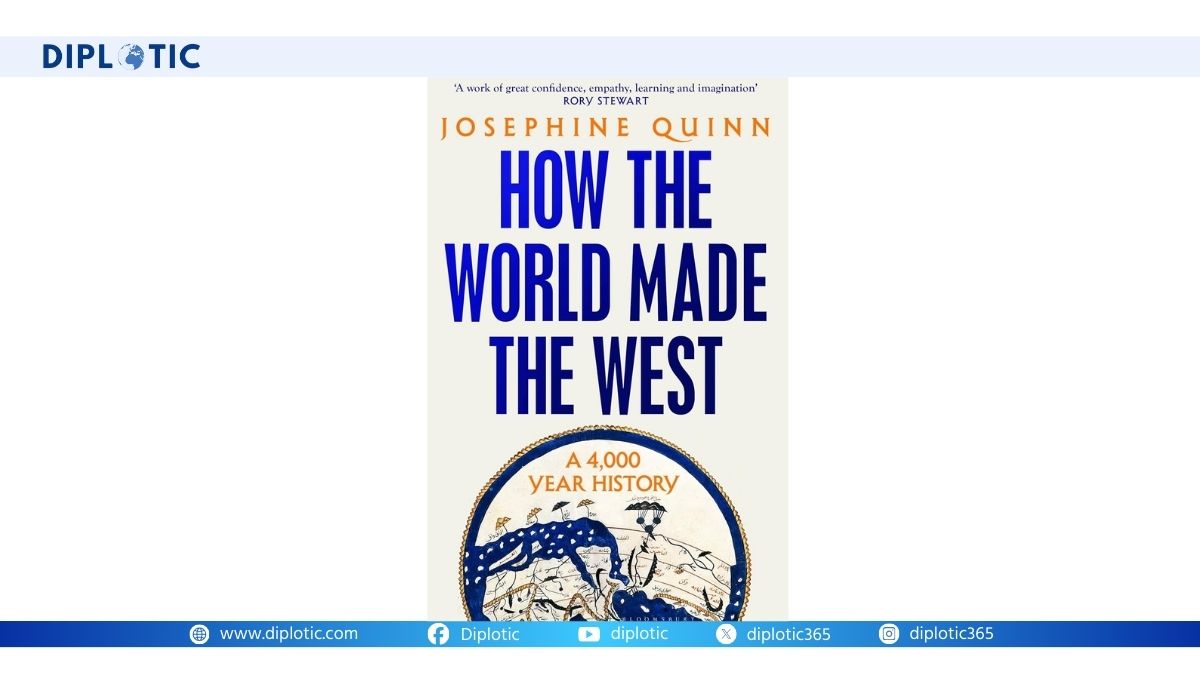
The idea of the West often appears clear and fixed in public debate. For many people, the West is a natural continuation of ancient Greece and Rome. In recent years, this view has been repeated even more strongly, especially as global tensions rise. Images of Western fighter jets operating over conflict zones and fears of rival powers appear to confirm that the world is divided into civilisations that have always been separate. But a closer look shows a different picture. A new book by Josephine Quinn argues that the story of the West is not a straight line from Athens to modern Europe. It is a long and complex history of learning, borrowing, trade, and movement across regions. This investigative review explores that argument by tracing how historians built the idea of the West, how it became popular, and how Quinn challenges it through evidence spread over four thousand years. Her central question is simple but important: Is the West truly a distinct civilisation, or is it a product of global exchange that shaped it over time? The answer leads the reader to reconsider what we think we know about the past and why these narratives continue to influence the present.
Where Did the Idea of the West Come From? A Look Behind the Myth
The image of the West as a pure and ancient civilisation did not emerge in antiquity. Instead, it was shaped much later, particularly in the nineteenth century. European colonial powers wanted a strong cultural story that justified their expansion. Scholars linked the British and French empires to the Greeks and Romans, suggesting a direct line of inheritance. They presented the classical world as a model of reason, beauty, and political order. This narrative became a powerful tool in education and politics. It allowed colonial rulers to claim they were carrying forward the achievements of Athens and Rome.
Yet early challenges to this view appeared in the twentieth century. Scholars like Martin Bernal argued that Greek culture itself drew heavily from older African and Near Eastern traditions. Bernal’s work suggested that the classical world was not isolated but part of a mixed and lively network of ideas. By reopening debates on the origins of classical knowledge, he gave space for Asian and African scholars to question how the West was defined. Quinn’s new work continues this line of inquiry but goes even further. She argues that civilisations are never isolated units. Instead, they grow in contact with others. Her study shows how early Europe borrowed and absorbed ideas from different cultures, long before colonial powers created a strict division between “West” and “Rest.” This raises a crucial question: if cultural learning is continuous, why do we still describe the West as a fixed civilisational entity? Quinn’s inquiry suggests that this belief is more recent and more political than many assume.
Did Ancient Greece and Rome Stand Alone? Evidence From Early Cultural Exchange
A major part of Quinn’s argument focuses on the ancient world. Greek and Roman societies are often presented as the roots of Western identity. But she highlights that they learned from other cultures in ways that were open and extensive. Greek irrigation systems, for example, were influenced by Assyrian methods. Egyptian sculptors trained Greek artists. When Rome grew into a major power, it absorbed Greek knowledge as well as practices from the wider Mediterranean and Near East. These connections were not accidental. They happened through trade, war, diplomacy, and travel.
Historical records support this view. Even the early division between Europe and Asia did not arise from a real cultural gap but from political narratives. Greek historian Herodotus helped shape the binary view of Greeks versus Persians. He referred to Persians as barbarians, a word that simply described people who did not speak Greek. Later, as the Greeks defeated the Persians in battles such as Salamis, this sense of difference became stronger. Literature from the era, such as Aeschylus’ play Persians, shows how victors often described others to reinforce their own superiority.
But this separation did not last long. After Alexander the Great conquered Persia, the Greek world became deeply connected to Asia. His campaigns spread Greek culture while absorbing local customs. The result was a mixed cultural space that included influences from India, Persia, and the eastern Mediterranean. Quinn argues that this period marks one of the earliest examples of large-scale multiculturalism. Far from being isolated, the classical world was built through movement and exchange. Her narrative challenges the idea that the West developed in a sealed space. Instead, these early interactions show how global the ancient world already was, even without modern technology.
What Happened After Rome? Global Links, Plague, and the Rewriting of History
Many histories describe the fall of Rome as the end of a long era of contact and learning. But Quinn shows that the link between Europe, Asia, and Africa continued long after. Trade routes, religious networks, and intellectual exchanges kept shaping societies. This situation changed sharply with the arrival of the Black Death in the fourteenth century. The plague spread quickly because of medieval globalisation. Merchants, diplomats, and travellers carried it across continents. The deaths that followed were catastrophic, and the shock weakened many of the old networks of contact.
This collapse did more than create economic change. It altered how people understood themselves. By the fifteenth century, European thinkers began to turn inward. Humanist scholars celebrated the classical past as a perfect model of learning. They described ancient Greece and Rome as pure sources of knowledge, overlooking their long history of exchange. Quinn argues that this shift was not simply intellectual. It was shaped by real political events. Europe’s expulsion of Jews and Muslims created a new divide between insiders and outsiders. This idea of the “other” helped define Europe more narrowly. From this point onward, classical heritage became a tool for drawing boundaries. The belief that European civilisation grew alone gained strength.
However, Quinn points out that this belief does not match historical evidence. She describes how conversion, trade, and even the stealing of ideas shaped what we now call the West. Knowledge moved across borders because people moved, fought, migrated, and learned from one another. But once the classical myth took hold, scholars and colonial governments used it to argue for a natural hierarchy of cultures. Writers like Macaulay and Gibbon reinforced these ideas. Their works shaped school systems and national identities for generations. Quinn’s book challenges these long-held assumptions by pointing to the many ways cultures merged long before Europe built the idea of a separate West.
Why Does This Debate Matter Today? Rethinking Power, Identity, and Global Influence
Quinn is not the first scholar to question civilisational thinking. Earlier writers, including South Asian scholars like Susantha Goonatilake, presented similar arguments about cross-cultural exchange. But Quinn’s work arrives at a time when global politics is once again framed through civilisational lenses. The idea of the West as a single unit shapes debates on war, migration, culture, and security. In many countries, political leaders speak of civilisational clashes, echoing the thesis popularised by Samuel Huntington in the 1990s. Quinn challenges this model by asking whether civilisations can ever be closed groups. Her answer is clear: history shows that they cannot.
Her narrative matters for the present because it shows how easy it is to simplify the past to defend political arguments. If people believe that the West grew alone, they may ignore the long history of shared ideas and mutual influence. They may treat cultural difference as permanent rather than shaped by time and movement. Quinn’s work offers an alternative. It suggests that global history is not a story of separate civilisations but of constant exchange. This approach invites readers to see current conflicts and alliances with a wider perspective.
Her book also raises questions about who gets to define history. She notes that scholars working outside Western institutions often receive less recognition, even when their ideas challenge old assumptions. This observation connects past and present by showing how power structures influence knowledge. The West’s dominance in global education continues to shape which stories become mainstream. Quinn’s investigation opens the door for more balanced narratives that include contributions from all regions.
Conclusion: A Shared Past for a Shared Future
The story of the West is often told as a straight line from ancient Greece to modern Europe. Josephine Quinn’s work challenges that picture by showing a long history of exchange, movement, and shared ideas. Her argument suggests that no civilisation grows alone. Trade, war, migration, learning, and even conflict create shared knowledge across borders. This perspective helps readers understand the past with more clarity and the present with more balance. As global politics continues to use civilisational lines to explain conflict, Quinn’s study offers a reminder that history is more connected than many assume. Her work invites us to rethink identity and influence in a world that is still shaped by old narratives.




