

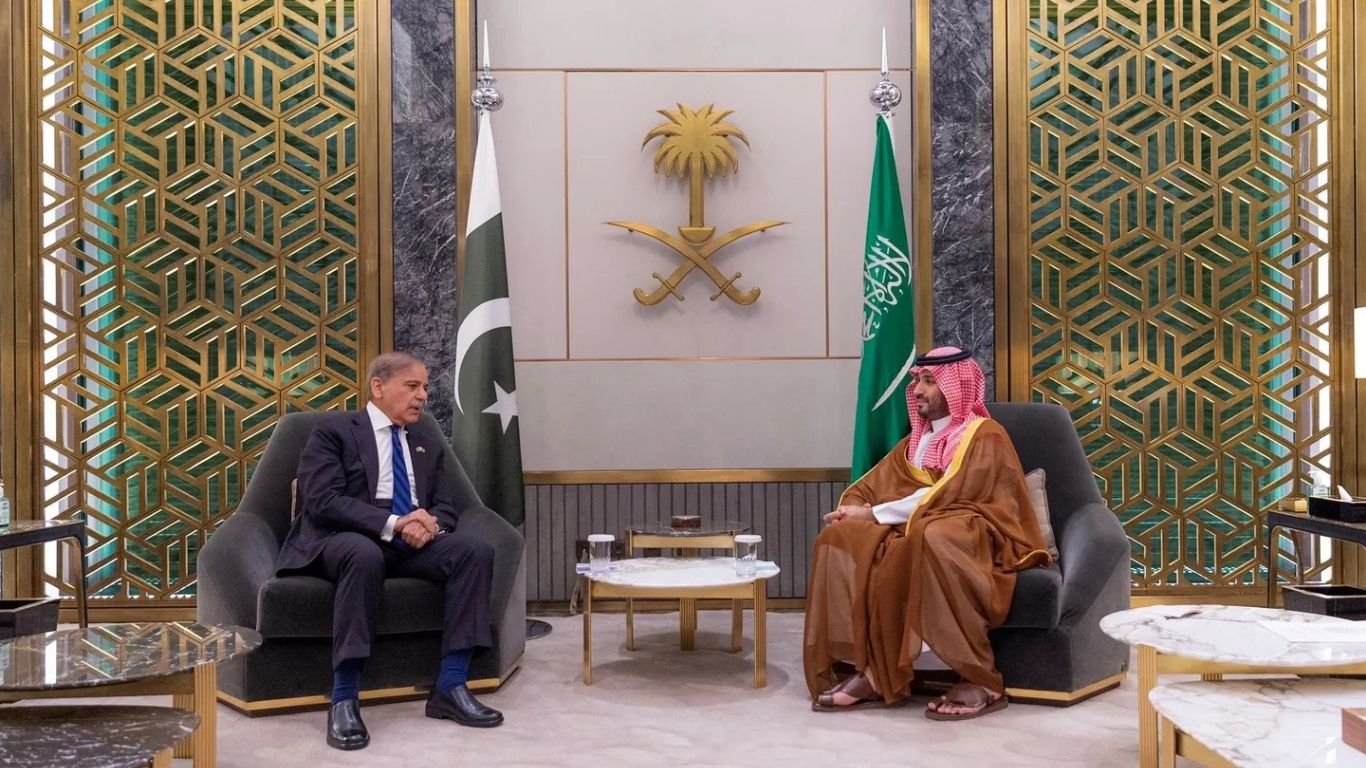
In September 2025, Saudi Arabia and Pakistan quietly signed a new Strategic Mutual Defence Agreement (SMDA)—a document that revived an older security partnership yet arrived with a dramatically different tone. At first glance, it seems like another routine affirmation of “brotherly ties.” After all, Pakistani troops have guarded the Kingdom for decades, and the two countries have always shared religious, political, and economic closeness. But beneath the ceremonial language and diplomatic warmth lies a deeper story: a shifting regional order, a Saudi Arabia anxious about new threats, and a Pakistan searching for a lifeline after its battlefield losses.
The agreement’s unusual phrase—“collective defence”—is what truly caught the attention of analysts from New Delhi to Tel Aviv. This is not typical Saudi wording. This is alliance language. And alliances rarely appear without strategic urgency.
New Delhi publicly downplayed the pact, saying it was aware of the negotiations and had already shared its concerns with Riyadh. But India’s quiet discomfort is revealing. This deal matured in the shadow of larger upheavals in the Middle East, not because of India–Pakistan competition. Yet the consequences for India’s security environment could still be significant, especially after Operation Sindoor, which reshaped India’s military posture for the first time since the Kargil conflict.
The SMDA’s birth did not happen in isolation. It came at a moment when Israel has asserted an overwhelming level of military power, striking Hamas operatives even outside Gaza—including in Doha. It also came after the “12-day war” failed to stop Iran’s push toward nuclear capability. These developments sharpened Saudi Arabia’s fears. The Kingdom is rich, ambitious, and determined to reshape its future under its Vision 2030 plans—but its military strength still lags behind its rivals. This imbalance has now given Pakistan a new chance to return to Middle Eastern geopolitics after years on the margins.
For Pakistan, this agreement is both a political and economic victory. The country is still adjusting to a situation where Prime Minister Shahbaz Sharif cannot travel abroad without the Army Chief, General Asim Munir, at his side—a visual symbol of the military’s firm grip on Pakistan’s strategic decisions. The SMDA offers Islamabad money, legitimacy, and regional relevance at a moment when it needs all three.
For Saudi Arabia, Pakistan offers manpower, battlefield experience, and a nuclear shadow that, though never explicitly mentioned, remains an unspoken part of the partnership. The Kingdom sees Pakistan as a force multiplier at a time when Israel is expanding its ambitions and Iran has survived yet another confrontation without giving up much.
The regional picture is just as complex. The Gaza conflict continues to reshape alliances. Israel’s stated aim to dismantle Hamas and Hezbollah, Syria’s fragile political comeback led by a former jihadist commander, Iran’s covert struggle with Israel, and the economic pressures created by war and energy markets—all of these factors shape Saudi calculations. Riyadh feels surrounded by instability and wants to ensure it is not left alone in the next major regional crisis.
Within this shifting landscape, Pakistan is slowly reintegrating into the Gulf’s security architecture. For years, it stood at the edge of Middle Eastern politics—part of forums, yes, but not central to the region’s strategic core. The SMDA marks a return to relevance.
For India, this is where the stakes rise. Over the last decade, New Delhi executed a successful “geoeconomics-first” outreach to the Gulf. It became a trusted economic partner to Saudi Arabia and the UAE, strong enough to separate its economic ties from its rivalries with Pakistan. But if Pakistan re-enters the Gulf as a security partner, it complicates India’s diplomatic balancing. Power equations shift. Access changes. So do expectations.
Europe, too, will watch this closely. The European Union remains an economic giant but a shrinking geopolitical actor. Any new security axis involving Saudi Arabia and Pakistan will force Brussels to rethink how it positions itself between India—its rising strategic partner—and Saudi Arabia, a key energy and investment partner.
And then there is China, the silent but unmistakable presence behind the scenes. Beijing’s relationship with Pakistan is deep and strategic. It supplied weapons used by Pakistan during Operation Sindoor, and it has steadily expanded its influence in the Middle East through energy, technology, and infrastructure. China does not need to be part of the SMDA to benefit from it; its two close partners—Pakistan and Saudi Arabia—are drawing closer on their own. The implications for India are obvious and troubling.
The Saudi–Pakistan defence pact is not a dramatic earthquake in global politics. But it is a tremor that reveals deeper shifts under the surface—shifts in power, alliances, and strategic fears. It signals a Middle East preparing for a new security era and a Pakistan eager to escape isolation. It also signals a challenge for India, which must now navigate a region where old lines are blurring and new alignments are forming.
In a fragile global order, where two nuclear-armed neighbours remain in constant tension, every such shift matters. The world will be watching how capitals—from New Delhi to Riyadh, from Beijing to Brussels—respond to this new layer in the security architecture of Asia and the Middle East.




