

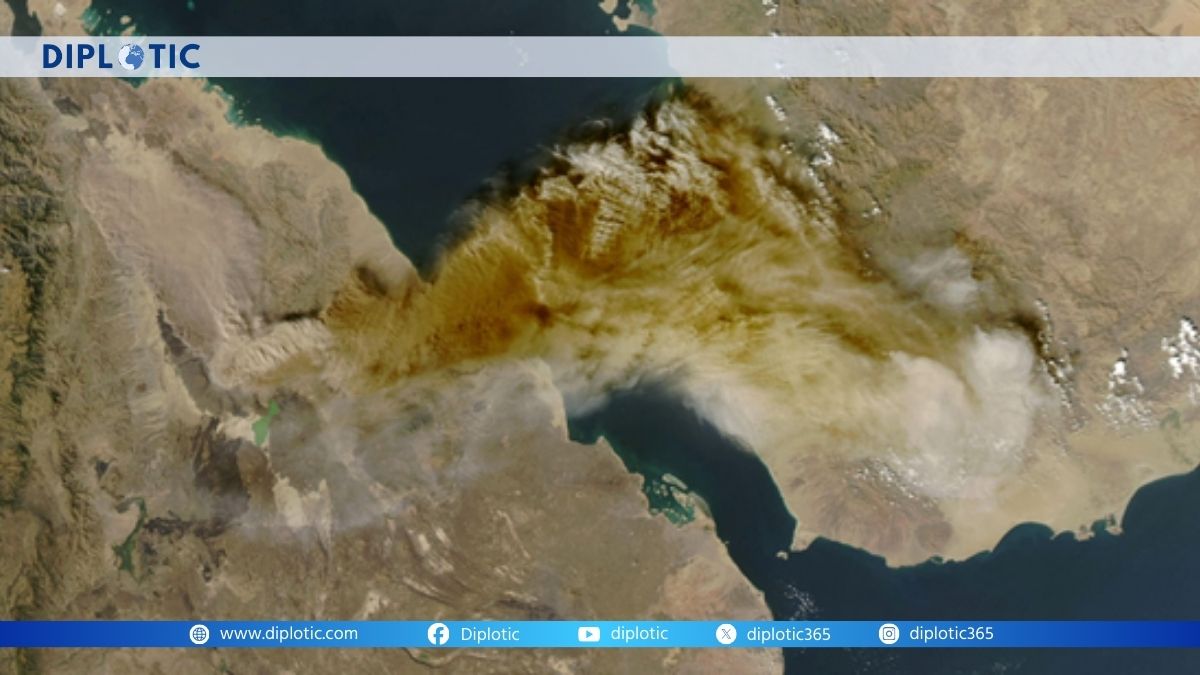
A long-dormant shield volcano in Ethiopia’s Afar region, Hayli Gubbi, erupted on November 23, 2025, its first known eruption in 12,000 years. The massive ash plume disrupted flights, blanketed villages in ash, and sent shockwaves across continents. Here’s what scientists and residents are saying.
A Volcano Awakens After 12,000 Years of Quiet
On November 23, 2025, a geological event of profound significance jolted not just Ethiopia but the wider world: Hayli Gubbi, a volcano that had lain silent for roughly 12,000 years, erupted violently, ejecting ash miles into the sky and sending tremors across a remote region. Situated in the arid northeast of Ethiopia, within the remote Afar region, Hayli Gubbi had long been considered dormant. There were no known eruptions during the current geological period, the Holocene Epoch that began at the end of the last Ice Age. But that long slumber ended abruptly, reminding the world how even ancient volcanoes can reawaken when subterranean conditions permit.
Where and What: Hayli Gubbi’s Geological Profile
Hayli Gubbi is a shield volcano, characterized by its broad, gently sloping sides and basalt-rich composition. Its summit rises to about 500 metres (approximately 1,620 feet) above sea level. The volcano is located at the southern extremity of the Erta Ale Range a chain of shield volcanoes that slice through the Afar Depression, a tectonically active zone where the African continent is slowly being pulled apart. Because the area is remote and understudied, it had not drawn much attention from volcanologists, and until now, there was no historical record of eruptions during the Holocene.
The Eruption: Ash, Shockwaves & An Atmospheric Wake-Up Call
Eyewitnesses described the eruption as sounding “like a sudden bomb.” In local villages near Hayli Gubbi, including the village of Afdera, people reported hearing a tremendous explosion and feeling shockwaves, followed by a massive column of ash rising into the sky. Satellite imagery captured what no one had seen in millennia: ash and gas plumes billowing up to 14 kilometers (about nine miles) into the atmosphere. The eruption lasted for several hours on Sunday, November 23, before the explosive phase subsided. But the effects spread far beyond the remote Ethiopian highlands.
Ripple Effects: From Local Villages to International Airspace
Local Impact Communities, Livestock, and Livelihoods
Although there have been no confirmed casualties or livestock deaths so far, the eruption has severely disrupted local life. Villages like Afdera were blanketed in ash, leaving grazeland covered, feed unavailable, and many pastoralist families now facing economic uncertainty.
Local residents described the scene with shock: one resident said the blast “felt like a sudden bomb thrown with smoke and ash.”
Given the remote nature of the region, limited infrastructure, and the dependence on livestock and salt-mining trades, the eruption’s economic consequences may be far-reaching. Experts warn that recovery could take months, especially if ash continues to affect grazing lands or pollute water sources.
Global Reach Ash Clouds Disrupt Aviation & Drift Across Continents
Within hours and days of the eruption, ash clouds from Hayli Gubbi had drifted across the Red Sea, moving toward Yemen and Oman, and even stretching into South Asia, including parts of India and northern Pakistan.
That prompted warnings from international aviation authorities. The Toulouse Volcanic Ash Advisory Centre (VAAC) issued alerts as ash moving at high altitudes threatened to damage aircraft engines and instruments.
In response, airlines cancelled or rerouted flights: some carriers suspended flights to Middle Eastern destinations, while others delayed or cancelled international routes between India and Gulf countries.
Though air quality experts initially noted that the ash remained mostly in the upper atmosphere and was unlikely to immediately worsen ground-level pollution in regions such as Delhi, the scope of disruption in transport, economy, and environment underscores the far-reaching implications of the eruption.
Why This Eruption Matters: What Scientists Are Learning
The eruption of Hayli Gubbi is a stark reminder of a few critical geological realities:
Dormant does not mean dead. Even volcanoes with no recorded activity for thousands of years can reawaken, especially if they lie within tectonically active zones such as the Afar Rift.
The eruption may suggest that more unrecognized volcanoes exist across under-studied regions, waiting to awaken. As one earth scientist noted following the eruption, “This ash column may be a clue to other, undocumented eruptions.”
The global reach of the ash plume crossing seas and continents highlights that volcanic events in remote corners can have transnational effects, ranging from aviation disruptions to atmospheric and environmental consequences.
In the short term, scientists are now carefully analyzing the ash composition, gas emissions, and satellite imagery to understand the nature of this eruption and evaluate whether Hayli Gubbi might remain active or become a long-term hazard.
What Comes Next?
For local communities, immediate priorities include assessing the damage to livestock, grazing lands, and water resources, as well as planning for possible future disruptions. Relief efforts may be needed if ash contamination affects soil, water, or air quality over prolonged periods.
For the global scientific and aviation community, this event serves as a wake-up call. Monitoring networks, especially in remote and understudied areas like the Afar region, may need expansion. Early-warning systems, satellite vigilance, and cross-border coordination will be essential to mitigate risk from future eruptions.
Meanwhile, environmental and climate researchers will closely monitor the impact of the ash and gases released. Large eruptions can influence local weather, air quality, and even atmospheric chemistry with potential knock-on effects far beyond the origin.
Final Thoughts: Nature’s Unpredictable Voice
The eruption of Hayli Gubbi after 12,000 years of silence is more than a geological curiosity; it is a powerful reminder of Earth’s dynamic forces. Dormant volcanoes are not necessarily extinct, and regions long considered stable can awaken without warning. As the ash settles over Ethiopian villages, drifts across oceans, and rouses scientists worldwide, the message is clear: the planet remains alive, restless, and always capable of surprising us.




