

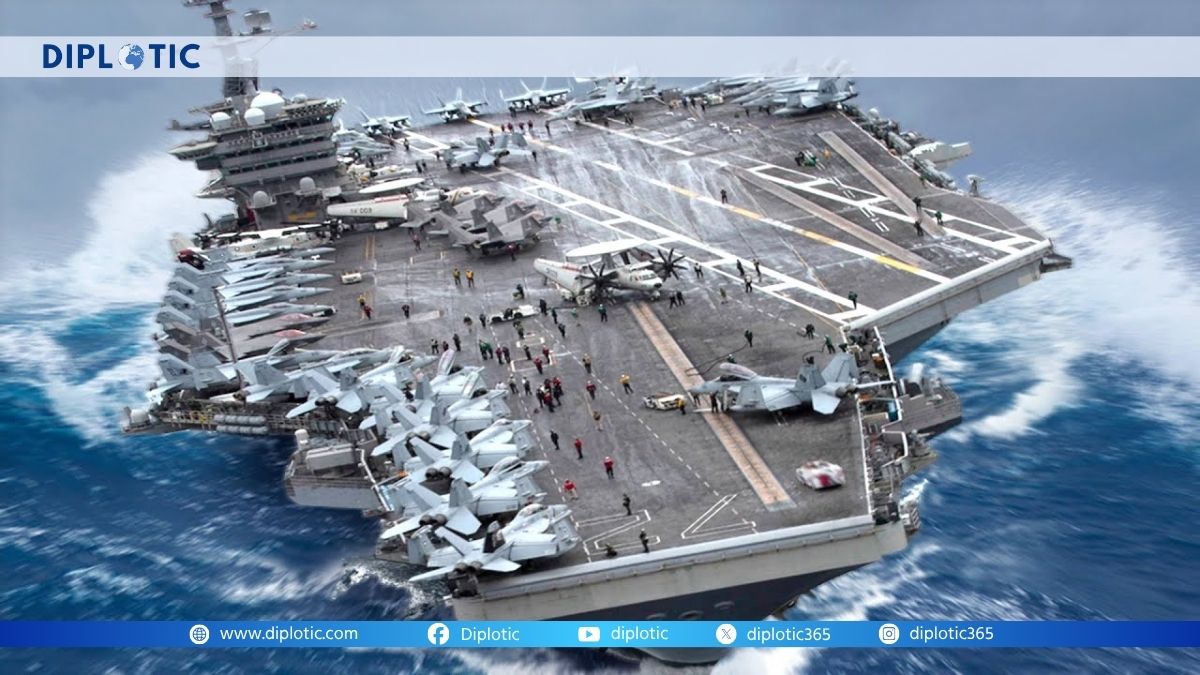
The arrival of the USS Gerald R. Ford, the world’s largest and most advanced aircraft carrier, in the Caribbean is a spectacle of raw military power. Its deployment is the centerpiece of the largest U.S. military buildup in Latin America in decades, a visible and intimidating presence off the coast of Venezuela. This move has sharply escalated a long-running confrontation between the United States and the government of Nicolás Maduro, pushing the region to a tense and uncertain brink. The official justification from Washington is a campaign against a “narco-terrorist” drug cartel it accuses the Maduro regime of running. Yet, the scale of the mobilization—which also includes marines, reaper drones, and elite special forces units—suggests ambitions that extend far beyond interdiction at sea. The situation is a volatile puzzle, with experts and former diplomats radically reassessing the odds of conflict. What just weeks ago was seen as a muscular negotiating tactic is now being viewed by some as a prelude to military action. The central, haunting question is whether this armada represents a genuine preparation for war or remains an unparalleled act of psychological pressure designed to achieve a political collapse without firing a single shot.
Why Has the Stakes in the Caribbean Suddenly Escalated?
The shift in perception from a show of force to a potential prelude of war is rooted in a dramatic change in the military facts on the ground. The initial deployments in August were significant but could be interpreted as part of a long-standing pattern of pressure against Caracas. The arrival of the USS Gerald R. Ford and its accompanying strike group, however, represents a qualitative leap. An aircraft carrier is not merely a ship; it is a floating sovereign base of air power, capable of projecting force hundreds of miles inland with its complement of fighter jets, electronic warfare aircraft, and surveillance systems. Its presence fundamentally alters the strategic calculus. This is compounded by the deployment of the same special forces helicopter unit used in the 1989 invasion of Panama to capture dictator Manuel Noriega, a historical parallel that sends an unmistakable message. Furthermore, President Trump’s continued authorization of airstrikes against alleged narco-boats demonstrates a willingness to use lethal force within the theater, setting a precedent and normalizing military action.
This tangible escalation has caused key observers to dramatically revise their assessments. James Story, the former U.S. ambassador to Venezuela, has publicly shifted his view. Just two months ago, he gave an 80% chance that the situation would result in no major action. Now, he believes there is an 80% chance it will evolve into some form of military strike, describing such an event as “imminent.” This flip in probability from a seasoned diplomat familiar with the players and the politics indicates that the military movements have crossed a threshold from posturing to preparation. The official rhetoric, labeling the Maduro government as a “narco-terrorist” entity, also provides a legal and political framework that could justify broader actions, similar to the kind of language used ahead of other U.S. interventions. For the Maduro government, the sight of the world’s most powerful warship on its doorstep is a threat of an entirely different magnitude than previous sanctions or diplomatic isolation, forcing it to confront the possibility that the United States is not bluffing this time.
What Are the Potential Scenarios for Military Action?
If the decision is made to move beyond a blockade and demonstrations of power, military planners likely have a range of options on the table, each with vastly different risks and consequences. The most limited scenario, and perhaps the most probable if action is taken, would involve targeted airstrikes. These could aim at symbolic military installations, command and control centers, or bases belonging to Colombian guerrilla groups that the U.S. alleges are operating with Maduro’s protection. Such strikes would be intended to degrade the regime’s military capabilities and demonstrate its vulnerability without committing to a full-scale invasion. A more dramatic option, floated by former Ambassador Story, is a “Soleimani-style attack”—a reference to the 2020 U.S. drone strike that killed a top Iranian general. This would involve targeting one of Maduro’s closest and most powerful allies, a decapitation strike aimed at crippling the regime’s leadership structure and potentially triggering its collapse from within.
The most extreme scenario, a full-scale invasion to topple Maduro, remains the least likely among most analysts, though its specter is raised by the historical echo of Panama. An invasion would be a colossal undertaking. Venezuela is a large, populous country with a complex terrain and a standing, if under-resourced, military. Urban combat in cities like Caracas would be devastatingly costly in terms of civilian and military lives. The Pentagon is likely acutely aware that overthrowing a government is the easy part; the ensuing responsibility of governing and stabilizing a nation of 28 million people is the true challenge. The goal of any military action, therefore, would likely be to create such overwhelming shock and pressure that the regime fractures internally. The ideal outcome for the U.S. would be for the show of force to spark a palace coup or a military uprising that removes Maduro without the U.S. having to fire the first shot on Venezuelan soil. This makes the current deployment a high-stakes game of chicken, where the U.S. is betting that the visible preparation for war will make the war itself unnecessary.
What Would Follow the Fall of the Maduro Regime?
For the Venezuelan opposition, which has struggled for years to dislodge Maduro through elections and protests, the U.S. military threat represents a potential shortcut to power. Opposition leader Maria Corina Machado has stated her movement is ready with plans for “the first 100 hours, the first 100 days” after a transition. However, the aftermath of regime change is a minefield of potential disasters that extends far beyond the initial euphoria. Experts point to several cautionary tales. One is Libya, where the overthrow of Muammar Gaddafi led not to freedom and stability but to a devastating civil war that fractured the country for years. Venezuela, with its vast territory, widespread criminal gangs, and heavily armed Colombian guerrilla groups operating within its borders, could easily descend into a similar state of factional violence, becoming a failed state on a massive scale.
Another troubling parallel is Afghanistan. Benjamin Gedan of the Stimson Center warns that Venezuela has far more in common with the complex, tribal, and protracted conflict of Afghanistan than with the quick, surgical invasion of Panama. Toppling Maduro could be the start of a decades-long insurgency, with remnants of the regime, colectivos, and other armed groups melting into the population and waging a guerrilla war that a new government, even with U.S. support, would be hard-pressed to contain. The country is already impoverished and politically polarized; a military conflict would shatter its remaining institutions and trigger a humanitarian catastrophe that could dwarf the current crisis, sending waves of refugees across the Americas. The economic and human cost of putting Venezuela “back together” after a war would be astronomical, a responsibility the United States would inevitably have to share. The prospect of victory, therefore, is shadowed by the specter of a quagmire, where the removal of a dictator is merely the prelude to a longer, more intractable, and more devastating conflict.
Conclusion: A Standoff Between Power and Uncertainty
The USS Gerald R. Ford, a symbol of unparalleled American military might, now sits as a silent question mark in the Caribbean. Its presence has brought the Venezuela crisis to a boiling point, creating a moment of extreme tension where the paths to war and to a negotiated solution exist side-by-side. The Trump administration appears to be betting that the sheer scale of this pressure will crack the Maduro regime from within, forcing concessions, a coup, or the leader’s exile. For his part, Maduro is playing the part of the defiant survivor, but the military reality outside his shores is undeniably new and threatening. The world watches to see if this is the ultimate bluff in a high-stakes game or the prelude to a conflict that would reshape Latin America. The true cost of this deployment will be measured not in the fuel consumed by the carrier group, but in whether it brings a peaceful resolution or unleashes a storm of violence and instability whose consequences would ripple far beyond the Venezuelan coast, leaving a legacy of chaos in place of a failed dictatorship.




