

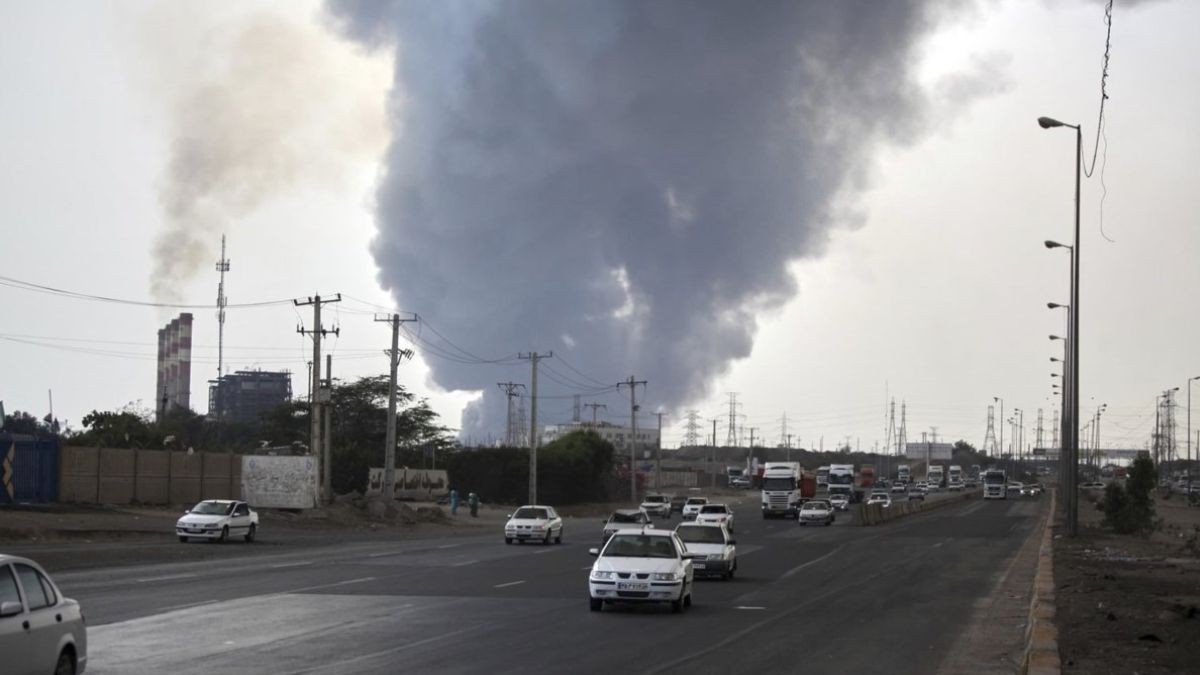
There’s a thick, gray smoke cloud rising from Iran today and no, it’s not the tired remains of international diplomacy. It’s actual smoke, the deadly kind, billowing from Bandar Abbas’s Shahid Rajaee Port after a massive explosion ripped through the facility, leaving four dead, more than 500 wounded, and a nation once again asking: “How much negligence does it take to set a country on fire?”
In the latest episode of “Everything That Could Go Wrong Has Gone Wrong,” Iranian state media and emergency services confirmed the ghastly toll: four human lives lost, and 516 injured souls some still reportedly trapped under the rubble. It’s the kind of devastating spectacle we’ve almost gotten numb to almost.
Smoke, Chaos, and Crumbling Trust
Videos geolocated by CNN show what looks like the world’s worst magic trick: a massive gray plume rising up from Shahid Rajaee, where, allegedly, improperly stored chemicals decided they’d had enough of human incompetence and ignited themselves into infamy.
As surveillance footage released by Mehr News Agency revealed, the blast detonated inside a warehouse at the port. Helicopters, those flying metal hopes, were later spotted dumping water onto the roaring inferno, a desperate attempt to douse a fire that had already spoken louder than any government statement ever could.
State media with the usual dispassionate shrug reported debris scattered across kilometers. Buildings battered, windows shattered, a whole region’s nerves left rattling like broken glass in the wind. Some sources whispered (because shouting is punishable) that people were trapped beneath the remains of a structure that once dared to call itself stable.
“Contained,” They Say But At What Cost?
Mohammad Ashouri Taziani, the region’s governor, gave the classic bureaucratic assurance: the injured were being shuttled to medical centers across Bandar Abbas, and the fire, he claimed, was “contained.”
Contained? In the same way a lion might be “contained” after it’s already eaten half the zoo.
In any case, the port crucial to Iran’s economy was promptly closed. Maritime operations suspended. (Translation: another economic artery temporarily severed, bleeding precious lifeblood Iran can ill afford to lose.)
Meanwhile, Iranian President Masoud Pezeshkian (still fresh in office and already drowning in crises) ordered an investigation, instructing his Interior Minister to descend upon the smoking ruins to “examine the dimensions of the accident.” (Because apparently, sending a minister to measure rubble is step one of every Iranian disaster playbook.)
A Chemical Cocktail Waiting to Ignite
The state-run IRIB broadcaster chimed in, finger-pointing at the chemical and sulfur storage zones of the port. Which, if you’ve been paying attention to how Iran manages hazardous materials, is about as surprising as a cat knocking over a glass.
Fatemeh Mohajerani, the government’s weary spokeswoman, admitted the obvious: determining the explosion’s cause might take some time. Preliminary whispers point toward improperly stored chemical containers, ticking time bombs that surprise! finally exploded.
“Until the fire is extinguished, it’s hard to ascertain the cause.”
Fatemeh Mohajerani, trying her best to explain the inexplicable
In other words, once the smoke clears, they’ll find someone suitably small to blame a poorly paid warehouse manager, perhaps and call it a day. Business as usual.
Shahid Rajaee: A Giant Built on Sand
The Shahid Rajaee Port complex isn’t some sleepy little dock; it’s Iran’s commercial juggernaut, sprawling over 2,400 hectares (source) that’s around 5,900 acres for those keeping score. It handles an eye-watering 70 million tons of cargo every year, including oil (because of course) and general shipments. Nearly 500,000 square meters of warehouses, 35 shipping berths an empire built to move mountains.
Yet behind this gleaming facade lies the rotten foundation: poor regulation, hazardous working conditions, and storage practices that seem to defy both common sense and international law. Shahid Rajaee may be a giant, but it’s one made of matchsticks and the matches just struck themselves.
When Negligence Becomes Routine
This isn’t some random freak accident. It’s a pattern a bone-deep rot visible to anyone willing to see. Iran’s infrastructural safety standards (or the lack thereof) are a chronic illness, exacerbated by corruption, international sanctions, and governmental indifference.
Remember the Plasco Building fire? Or the horrific Abadan Metropol building collapse just a few years ago? Every disaster is met with hand-wringing, promises of reform, and investigations that vanish into bureaucratic black holes.
This isn’t misfortune it’s malpractice.
Real Questions, No Real Answers
And so we find ourselves, yet again, asking:
- Why were volatile chemicals stored in vulnerable conditions?
- Who signed off on safety inspections (assuming they even happened)?
- What penalties if any will those responsible face?
If history is any guide, the answers will be obfuscated under mountains of jargon and sacrificial scapegoats.
Because when those at the top are immune, it’s the powerless who pay the ultimate price.
“Injustice anywhere is a threat to justice everywhere.”
Martin Luther King Jr., still screaming across decades into deaf ears
The Cost of Silence
For the families of the four victims, for the 516 wounded, for the workers whose livelihoods now lie buried beneath charred steel beams there are no slogans grand enough, no compensation sufficient enough.
The real tragedy isn’t the blast itself. It’s that it was entirely, gruesomely, preventable.
And unless this culture of corruption and complacency is ripped out by the roots unless someone finally dares to break the cycle it will happen again. Maybe at another port. Maybe at a school. Maybe at a hospital. But it will happen.
Because unchecked power and unaccountable governance don’t just kill slowly. Sometimes, they explode.




